

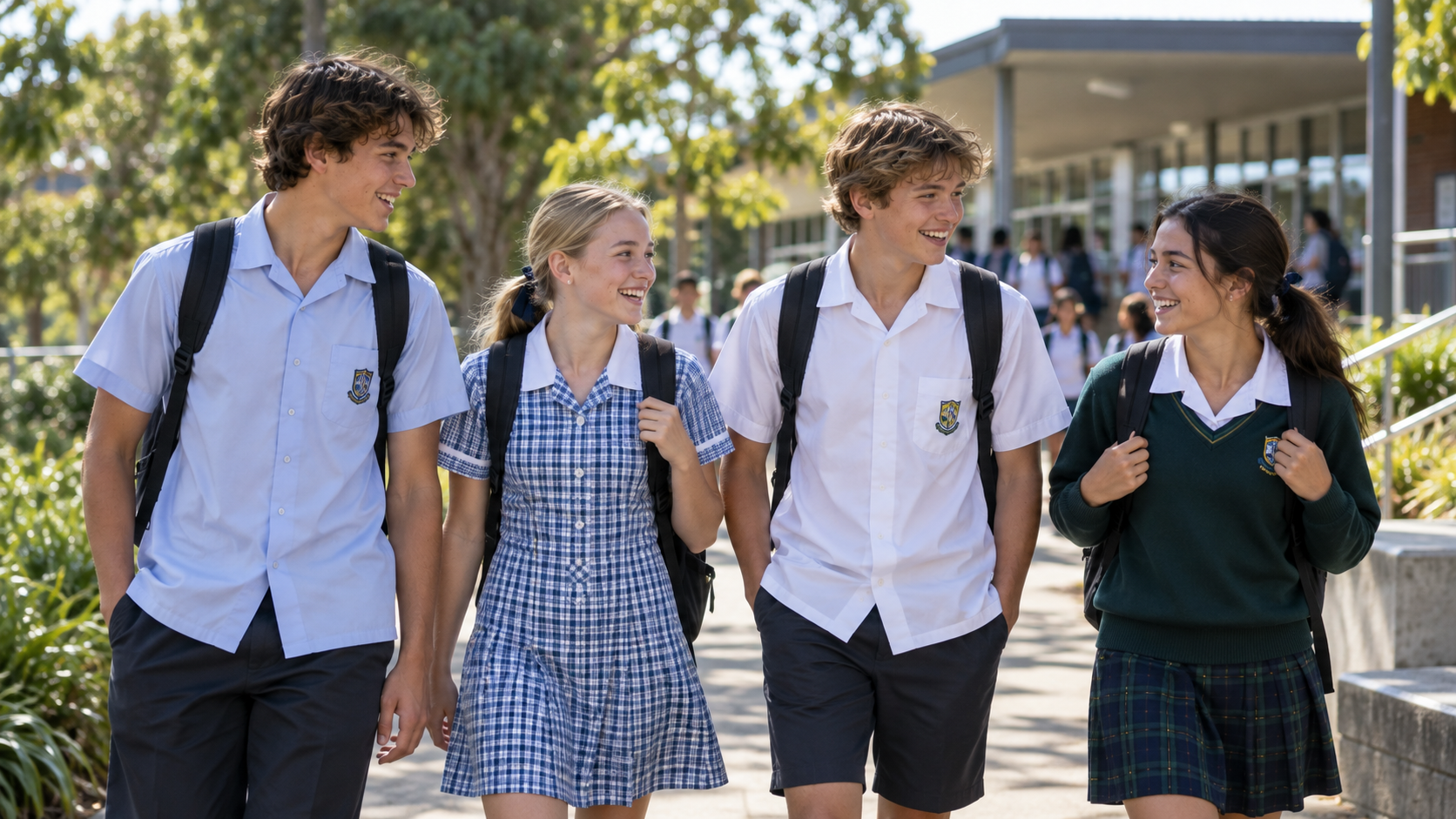
Every year when Year 12 and NAPLAN results are released, many families scour the tables to see which schools have performed “best”. Media headlines clickbait about schools that have topped the league tables, or most improved their scores.
We are told that choosing a school is one of the biggest decisions you’ll make for your child, and it can often feel overwhelming. Between conflicting headlines and constantly changing league tables, advice from other parents and playground tittle tattle, it’s a confusing information overload.
So what does make for not just a good public school, but a great public school for your child?
If you’re wondering where to begin, you’re not alone!
The evidence and research offers a much clearer picture of what actually matters over the headlines, the rumour mill or even your gut feeling.
So here’s what the experts and data about quality public education, how public school enrolments actually work, what’s worth asking before you enrol you child — and what you can do once they’re there.
So let’s get started!
WHAT ACTUALLY MAKES A PUBLIC SCHOOL “GOOD”?
What makes a public school good? The first thing to ask is: what’s it good for, and who’s it good for?
Our children are all different. The first thing is to know what your child is interested in. For many parents, academic results might be most important, especially given how much emphasis is placed in the media and websites like MySchool on academic achievements or test results.
So what makes a public school “good” isn’t so much about what its annual NAPLAN or other results might be, but where your child is going to be happiest and most motivated. Raw NAPLAN data isn’t the best predictor of how a school performs or might improve, and the results are only a snapshot of a particular moment.
But there are factors that do make a school “good” — and things you can do to make it even better.
WHAT’S THE BIGGEST FACTOR IN WHERE YOUR CHILD GOES TO PUBLIC SCHOOL?
Here’s the thing. While league tables like MySchool might suggest you can choose your child’s public school, most public school enrolment in Australia runs on a “catchment area” system. That is, your address determines which government school you’re entitled to attend. Generally, your State Department of Education allocates a catchment area around every school, and if you live within it, you’re in.
You can apply for an out-of-area enrolment if you live outside a particular school’s catchment area, but whether your child gets a place depends on how many places are available after local families are enrolled. Selective schools permit out-of-area enrolments. These are determined by entrance tests and application processes that are often outside the usual public school enrolment deadlines, and you’ll need to check these, often up to a year in advance.
And given how tough and exhausting long commutes are, also consider whether you really want your child to go somewhere far away, knowing you’ll either have to tack on hours to your daily work trip, or they’ll lose out on precious family and play time, or be too tired to study?
The key here isn’t to choose a school, but help your child have a great education, by making sure they have access to the things that will help them to thrive.
WHAT WORKS BEST?
Great facilities and a flashy website don’t tell you much. The best schools aren’t the ones that do the marketing well.
They’re the ones that do the basics well for every child at school, not just the top few and the good news is that our public schools cater for all children.
In 2025, the NSW Centre for Education Statistics and Evaluation (CESE) published a guide on what it found via research and data to work best in “excellent” schools.[1] This included:
HIGH EXPECTATIONS: Teachers provide challenging and ambitious learning activities that help students meet their full potential through consistent effort and improvement.
CLASSROOM MANAGEMENT: Teachers create the conditions for learning by minimising disruptions, maximising instruction time and encouraging students to engage in learning.
WELLBEING: Teachers, school leaders and parents facilitate student wellbeing through a sense of belonging, an ongoing commitment to cultural inclusivity, promoting positive relationships and supporting student resilience.
COLLABORATION: Teachers, school leaders and parents work together to share evidence-informed practices, knowledge and problem-solving to achieve agreed learning goals.
WHAT MATTERS MOST IN A GOOD PUBLIC SCHOOL?
We’ve all hopefully had that wonderful, inspiring teacher who changed our lives. Not just because they helped us achieve better results, but because they cared about us, our interests and our wellbeing.
If there’s one single factor outside of a child’s individual abilities, it’s the one person apart from you who spends most of every day with your child: their teacher.
Professor John Hattie, Director of the Melbourne Education Research Institute at the University of Melbourne, surveyed more than 800 studies in the largest ever synthesis of the quantitative measures of different factors like curriculum, class sizes and teacher quality on educational outcomes. He found that teachers’ effectiveness, and their belief they can influence and improve student learning has one of the largest effects on academic achievement of any other factor — even more than class size.[2]
Let’s face it: a small class with disengaged teachers and kids will do less for your child’s education than a larger class with great, engaging teachers.
A big part of that is school culture — how happy and supported kids and teachers are, and how active and connected the wider school community is.
It’s those unquantifiable factors that can tell you more than any score about how good a school is or can be.
SO WHAT’S MORE IMPORTANT THAN ACADEMICS ALONE?
CESE conducts regular wide-ranging reviews of wellbeing data and literature. Time and time again, they point to a strong relationship between student wellbeing and learning outcomes[iii] — as has a 2024 UNESCO global report on happiness in and for learning, which found that joy, relationships and belonging didn’t just contribute to wellbeing but also to achievement.[iv]
Kids who feel connected, valued, listened to and supported at school will engage more meaningfully, learn more and achieve more, especially when they’re close to home and among friends. But anxiety can lead to disengagement, demotivation and lack of achievement.
And that’s especially true for so-called “high performing” schools with high test results or league table places. While these schools may be just right fro some children, research has shown that students at such schools often suffer greater anxiety, lower self esteem,[v] minimal life satisfaction,[vi] and marginally only higher academic outcomes[vii] than those who narrowly missed out and attended comprehensive schools with good cultures and community.
And don’t forget: with around 2.6 million kids — or around 62.8% of all Australian school students — enrolled in public schools in 2025,[viii] that includes kids with special needs, or who arrived with no English, or whose families are doing it tough this year.
Kids from across the community.
That diversity is exactly who and what great public education is for.
Because a great public school doesn’t discriminate. A great public school offers everyone the same opportunity to learn and thrive.
And a great public school reflects Australia’s rich diversity, enabling your child to engage and relate to people from all walks of life.
But that’s why it’s worth visiting a school, and seeing how staff interact with students, parents and each other.
When you visit a school, look around. How does it feel? Is there a positive vibe? Do kids look happy and chatty? Or do they look miserable and silent? How do they interact with and include each other?
How do teachers supervise them in the playground and classroom? With compassion and guidance, or strict discipline? What’s the school’s approach to bullying and inclusion? What creative or extracurricular activities do they offer?
What kind of professional development opportunities do staff have to continuously improve? How long has it retained its senior staff, and what kind of mentoring are new staff and graduate teachers getting?
Most importantly, would your child be eager to walk through the school gates on a Monday morning, or try to avoid it?
WHAT SHOULD YOU ASK WHEN YOU VISIT A PUBLIC SCHOOL?
Former principal and education thought leader Chris Bonnor suggests asking these questions when you’re visiting a school. As he says, ‘If parents across Australia keep asking just the first three of these questions they would have a collective power to influence school change.’
- What really sparks learning in kids? How do you ensure that all your students are engaged in what the school offers and does?
- How do you know if they are really learning for the long term?
- How often do teachers spend time in each other’s classrooms and reflect on their teaching? Are your teachers learners as well?
- Tell me your policy on (insert topic). Does it work and how do you know?
- What policies and practices do you feel are quite useless? How can you change these?
And if you really want to know what a school’s like, and you’re permitted to, ask the real experts: the students. Go beyond just yes or no answers and ask questions like:
- What do you like about your school?
- What parts are most worthwhile?
- What would you change if you could? Why?
- What do you want to be (not just do) when you leave school?[ix]
You’ll notice that none of these questions are about facilities or funding. They’re about teaching, learning, and culture.
WHAT CAN YOU DO TO NOT JUST CHOOSE A GOOD SCHOOL, BUT HELP MAKE ONE BETTER?
Get involved! It’s not just teacher effectiveness that determines educational outcomes. A 2007 meta-analysis of dozens of studies on student achievement found that consistent, meaningful, positive parental involvement had a significant influence on their children’s academic outcomes. [x]
That doesn’t mean you have to be on canteen duty every week, or get elected to the P&C. It might be volunteering for reading groups or excursions, helping out with fetes or working bees, or just attending assemblies, concerts or Book Week parades, to not only connect you to your child, but your school community.
It doesn’t mean being a helicopter parent either. But asking about homework, getting to know your kid’s teachers and other parents, and letting your kid know that their school and its community matter by getting involved can make a huge difference.[xi]
In the OECD’s 2022 Program for International Student Assessment (PISA) report, where principals reported more regular conversations with parents about student progress, students scored six points higher in maths..[xii]
Schools with actively involved parents tend to have more resources, more extracurricular activities and a greater sense of community and belonging, leading to greater wellbeing and educational outcomes.
In the end, it isn’t just about finding a “good” public school — it’s about helping to make it even better by getting involved.
IN THE END…
A good public school isn’t just the “right” postcode. It’s more than a place on league tables or test rankings.
It’s all the things that actually make a good public school great: a close, connected and inclusive school community, engaged and proactive teachers, and a focus that goes beyond academic results and includes creativity and wellbeing.
A good school nurtures creativity, fosters inclusivity and community, works with families, supports wellbeing, helps students and teachers develop and improve, and guides kids beyond academic results to become capable “whole” people who care and contribute.
And remember that one of the most important factors in making your school even better is you and your involvement.
But in the end. the right public school is the one where your child belongs, can learn and will thrive.
REFERENCES
[1] Hattie, J. (2009). Visible learning: A synthesis of over 800 meta-analyses relating to achievement. Routledge.
[1] CESE (Centre for Education Statistics and Evaluation). (2015, May 21). ‘Student wellbeing’. NSW Department of Education. https://education.nsw.gov.au/about-us/education-data-and-research/cese/publications/literature-reviews/student-wellbeing
[1] United Nations Educational, Scientific and Cultural Organisation (UNESCO). (2024). Why the world needs happy schools. Global report on happiness in and for learning. UNESDOC Digital Library. https://unesdoc.unesco.org/ark:/48223/pf0000389119
[1] Marsh, H.W. & Hau, K.-T. (2003, November). ‘Negative Effects of Academically Selective Schools on Academic Self-concept: Cross- Cultural Comparisons of Australian Results with those in 26 Countries’. HAU03758. In New Zealand Association for Research in Education and Australian Association for Research in Education joint Conference (pp. 31). http://www.aare.edu.au/03pap/abs03.htm#H HAU03758 / https://www.academia.edu/83430974/Negative_Effects_of_Academically_Selective_Schools_on_Academic_Self_concept_Cross_Cultural_Comparisons_of_Australian_Results_with_those_in_26_Countries
[1] Tham, M., Wade, A. & Huo, S. (2024, July 8). ‘Does going to a selective school make you more likely to go to uni, get a job and be satisfied in life?’ The Conversation. https://theconversation.com/does-going-to-a-selective-school-make-you-more-likely-to-go-to-uni-get-a-job-and-be-satisfied-in-life-232254
[1] Houng, B. & Ryan, C. (2018, June). Achievement Gains from Attendance at Selective High Schools. Working Paper 8/18, Working Paper Series. https://melbourneinstitute.unimelb.edu.au/__data/assets/pdf_file/0009/2810952/wp2018n08.pdf
[1] Australian Bureau of Statistics. (2026, March 5). Schools, 2025. https://www.abs.gov.au/statistics/people/education/schools/latest-release
[1] Bonnor, C. (2016, February 11). ‘What Makes a Good School?’ Centre for Professional Learning. https://cpl.nswtf.org.au/journal/semester-1-2016/what-makes-a-good-school/
[1] Jeynes, W. H. (2007). ‘The relationship between parental involvement and urban secondary school student academic achievement: A meta-analysis’. Urban Education, 42(1), 82–110. https://doi.org/10.1177/0042085906293818
[1] Raising Children Network. (2024, July 01). ‘Schools, teachers and parents: building strong partnerships’. https://raisingchildren.net.au/school-age/school-learning/working-with-schools-teachers/relationship-with-school
