

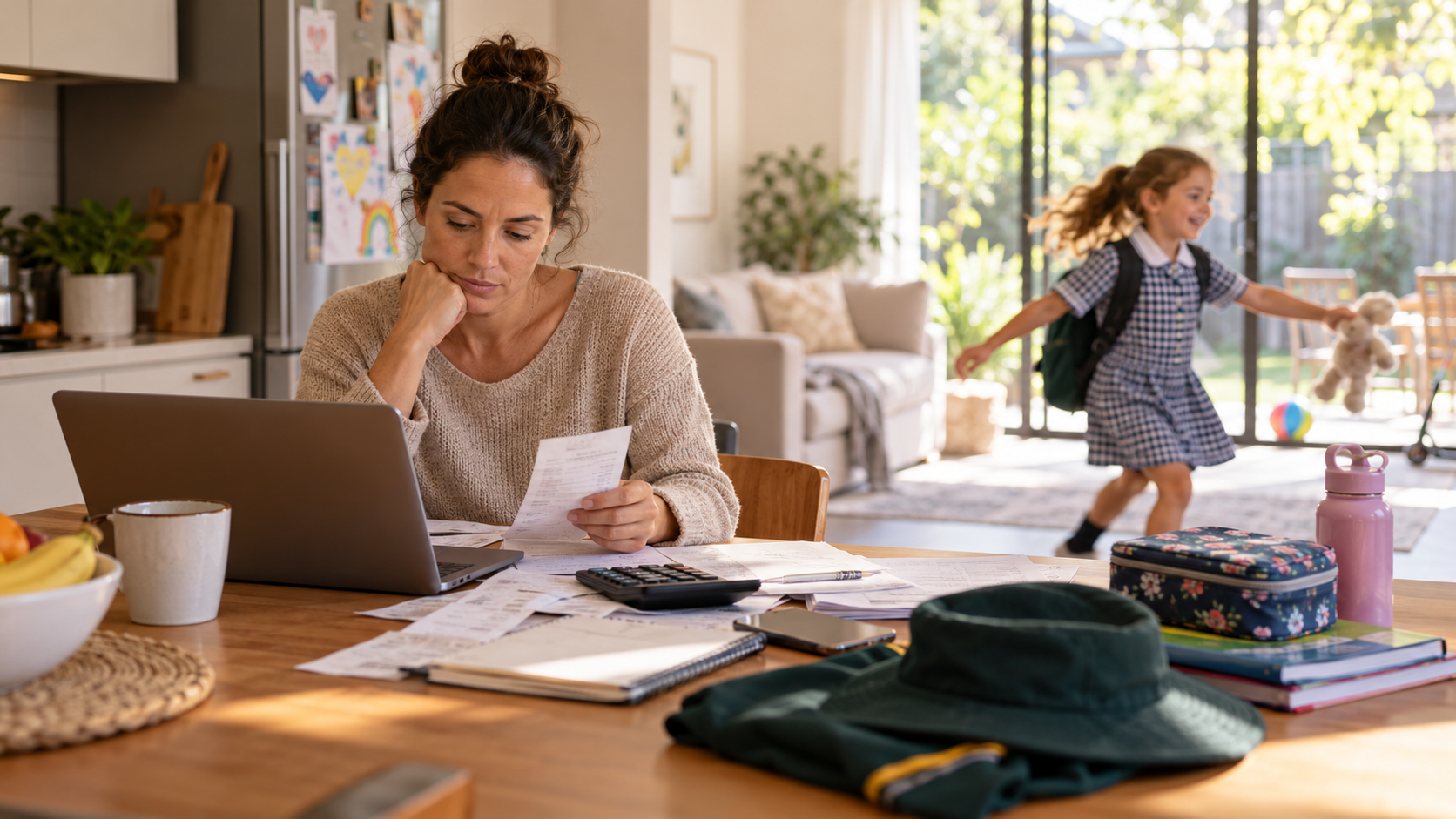
For many of us, choosing what school their child goes to is one of the biggest financial decisions we’ll make, with the cost of education soaring to over $50,000 a year for some elite private schools.
Public schools, on the other hand, don’t charge for tuition. But free tuition doesn’t mean there aren’t school costs along the way, as any parent scrambling for uniforms, shoes, lunchboxes and notebooks before school starts knows all too well.
So what does public school really cost in Australia?
BUT PUBLIC SCHOOL’S FREE, RIGHT?
Well, yes, and no. Tuition is free. Public schools don’t charge you a fee for teaching the core curriculum, and enrolment is free too.
But given public schools fund classroom supplies, core curriculum delivery, technology subscriptions and infrastructure from their own budgets, what they can do is ask you to make a voluntary school contribution. For example, in NSW public schools in 2026, that contribution is capped at $51 a year in primary schools and $110 in secondary schools.
Schools may also request elective subject contributions, for things like ingredients in food technology or instrument hire in band. There’s no charge those for mandatory subjects like maths, English or science.
Voluntary really does mean voluntary. No student in a public school can be denied being taught the curriculum, meeting syllabus requirements, joining in broader school activities, or being otherwise penalised, because a voluntary contribution hasn’t been paid.
That means if money’s tight, your child can still participate and, rather than being pursued for non-payment, you can ask for confidential hardship support, payment plans and exemptions if you need them.
So WHAT DOES public school COST?
Well, there are still things you need to pay for, such as uniforms, devices, camps, buses and excursions.
According to a 2026 Resolve/Futurity survey, 90 percent of parents believe education is extremely or very important to their child thriving in life
Alarmingly, 1 in 3 families, roughly 819,000 households, can’t afford back-to-school expenses that many of us take for granted, such as stationery and uniforms. 13% say they’ll have to go into debt to pay for back-to-school costs, and four percent say their child will have to go without.
In a 2023 survey by the national public school parent organisation revealed a rise in the use of after pay to cope with back to schools costs, around 14% claimed to have been using it regularly.
It’s estimated the cost of raising a child can be anywhere from $130,000 to $300,000 over 18 years — before you even factor in childcare fees and the cost of education. Futurity Investment Group modelled the cost of educating one child from kindy to Year 12 between 2026 and 2038.
Averaged across all major cities, that worked out to $113,594 for public schools, with regional and remote government schooling costing an average $94,842.
WHAT can you do to reduce school costs – and the cost of schooling?
Still, there are lots of things you can do to reduce school costs.
- • Spread them out across the year when they’re needed, rather than buying everything up front — like sports or winter uniforms.
- • Buy second-hand uniforms, books and devices.
- • Look for sales and discounts, and find out about government programs, concessions and rebates.
- • Sock away school fee or voluntary contributions instalments regularly so you can keep on top of them.
- • Ask for financial support or payment plans if you need them.
- • Apply for education scholarships — especially ours, which support students from primary to university.
So, what’s the real cost of education and why does it matter?
For families, that opportunity can come down to everyday things: having the equipment a child needs, being able to join an excursion, or getting extra learning support. A Public Education Foundation scholarship can ease pressure on the family budget and helping students participate more fully in school life.
The amount a family can afford to spend should never set the limit on a child’s ambitions. A scholarship offers practical support—and encouragement to keep learning, build confidence and explore what comes next.
Those opportunities matter beyond the school gates, opening pathways that might otherwise be harder to reach. That is the promise of greater social mobility, and a reason to invest in the skills, productivity and connections that strengthen our communities.
If education costs are making it harder for your child to take part, exploring a PEF scholarship is a positive step towards more possibilities.
Supporting public education means better outcomes for all of us — not just at school, but beyond.
And you can’t put a price on that.
REFERENCES
NSW Department of Education. (2026, August 5). Enrolment. https://education.nsw.gov.au/schooling/parents-and-carers/choosing-a-school-setting/enrolment
NSW Department of Education. (2026, August 26). Enrolment. https://education.nsw.gov.au/schooling/parents-and-carers/choosing-a-school-setting/enrolment
Harris, C. (2025, January 28). ‘The schools that have asked parents to pay for paper, tissues and markers.’ The Sydney Morning Herald. https://www.smh.com.au/national/nsw/the-school-that-has-asked-parents-to-pay-for-paper-20250127-p5l7kg.html
NSW Department of Education. (2026(2026b, May 27). Voluntary school contributions and elective subject contributions. https://education.nsw.gov.au/about-us/strategies-and-reports/schools-funding/voluntary-school-contributions
NSW Department of Education. (2026, May 27). Voluntary school contributions and elective subject contributions. https://education.nsw.gov.au/about-us/strategies-and-reports/schools-funding/voluntary-school-contributions
NSW Department of Education. (n.d.) Get help with costs. https://www.nsw.gov.au/education-and-training/primary-and-high-school/starting-primary-school/get-help-costs / my.gov.au. (2026, March 10). Help with education costs. https://my.gov.au/en/services/work/managing-the-cost-of-living/managing-household-costs/help-with-education-costs
Sudharshan, S. & Godfrey, J. (2026, April 9). Back to school costs and statistics for 2026. https://www.finder.com.au/insights/back-to-school-costs
Hunter, G. R. & Thach, C. (2026, July 22). ‘The cost of raising children in Australia.’ Finder. https://www.finder.com.au/life-insurance/life-insurance-and-the-cost-of-raising-children / Phillips, B. (2025, October 29). ‘How much does it really cost to raise a child? An expert does the maths.’ The Conversation. https://theconversation.com/how-much-does-it-really-cost-to-raise-a-child-an-expert-does-the-maths-266048 / Wright, S. (2026, June 8). ‘Raising a child costs much as a small mortgage – and that’s before you put education into the mix.’ The Age. https://www.theage.com.au/politics/federal/raising-a-child-today-costs-as-much-as-a-small-mortgage-and-that-s-before-you-put-education-on-the-tab-20260521-p5zzhk.html?collection=p602p4&gb=1
Futurity Investment Group. (2026, January). The cost of education 2026. https://www.futurityinvest.com.au/docs/default-source/default-document-library/cost-of-education-2026—full-report—futurity.pdf
Futurity Investment Group. (2026, January 13). The cost of education in New South Wales 2026. https://www.futurityinvest.com.au/insights/futurity-blog/2026/01/13/cost-of-education-in-new-south-wales-2026
Australian Bureau of Statistics. (2026, March 5). Schools, 2025. https://www.abs.gov.au/statistics/people/education/schools/latest-release
Predavec, S. (2026, June). ‘Poll: Chronic underfunding is driving the exodus to private schools.’ The Australia Institute. https://australiainstitute.org.au/wp-content/uploads/2026/06/P2044-Chronic-underfunding-is-driving-the-exodus-to-private-schools-Web.pdf
OECD. (2016, November 11). Regulating Publicly Funded Private Schools. OECD Education Working Papers. https://www.oecd.org/en/publications/regulating-publicly-funded-private-schools_5jln6jcg80r4-en.html /
OECD. (2018). Equity in Education: Breaking Down Barriers to Social Mobility, PISA, OECD Publishing, Paris. https://doi.org/10.1787/9789264073234-en
